what are the biggest challenges costco will experience in trying to expand globally
India is at a tipping point, both in terms of economic growth and in the human development of its more than ane billion citizens. The country is the sixth largest economy in the world, with a Gross domestic product of $2.half-dozen trillion in 2017. Its GDP growth charge per unit for 2019 is projected to be nigh seven.5%, as it continues to be a major engine of global economical growth. It does this while being the world's largest democracy and the earth'due south second most populous nation, with nigh one.35 billion people spread across hundreds of thousands of large urban centres, small towns and rural clusters.
The Earth Economic Forum'due south Insight Report, "Future of Consumption in Fast-Growth Consumer Markets: India", in collaboration with Bain & Company, paints a vision anchored in rising incomes and a wide-based pattern of growth and benefit-sharing. India is growing its heart class and lifting almost 25 million households out of poverty.
While sharing an overall strong positive outlook for the country'southward consumption future, the report emphasises how unlocking India'due south massive unsaid economical potential in the futurity depends on accelerating and sustaining its upwards trajectory on key man development indicators and aiming for inclusive progress.
The future presents an opportunity for India to tackle the following three big challenges.
ane. Skill development and employment for the future workforce
Co-ordinate to the Globe Economic Forum'southward written report "The Future of Jobs 2018", more than than half of Indian workers volition require reskilling past 2022 to meet the talent demands of the future. They will each require an actress 100 days of learning, on boilerplate.
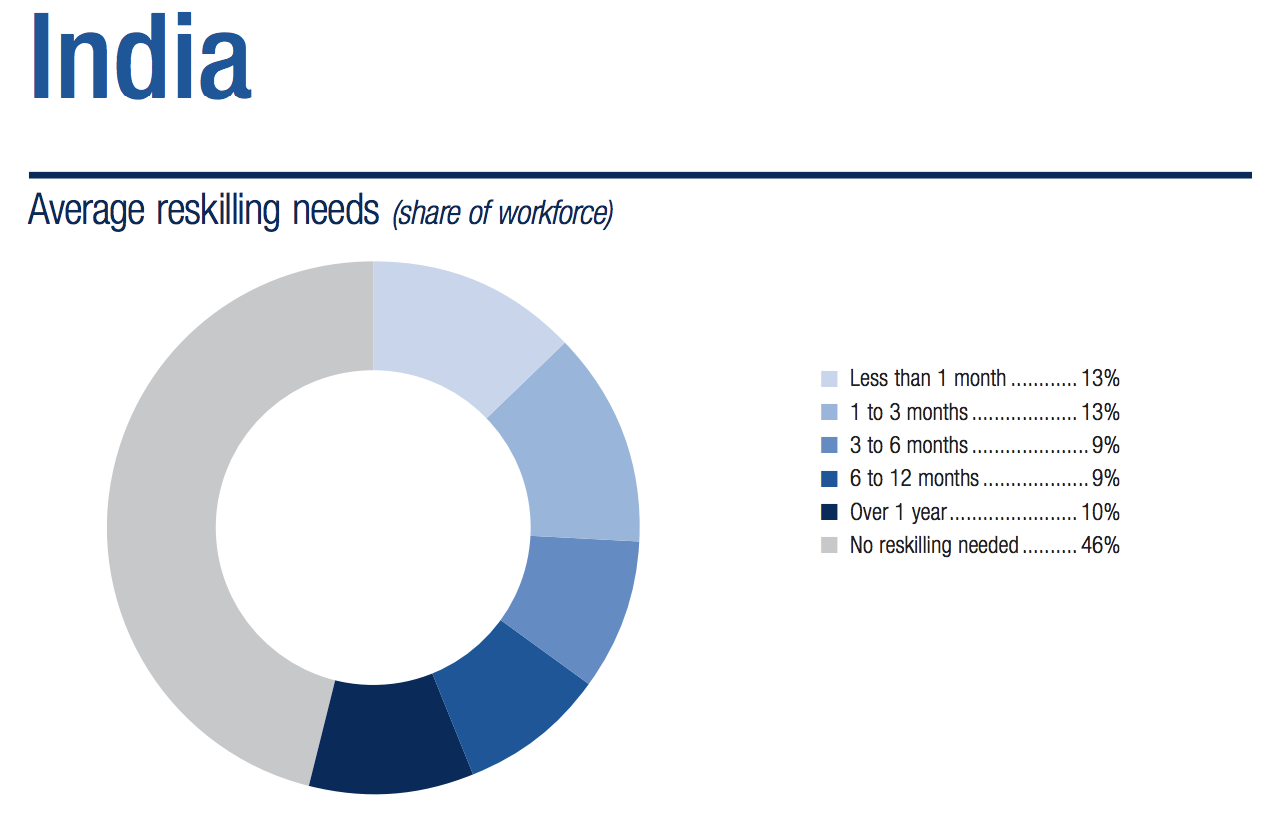
At that place are iv dimensions to the challenge of employment skills. First, the education system focuses on gaining conceptual cognition, rather than tangible skills which ensure employability. 2d, there are more jobs in the breezy economic system than in the formal economic system (eighty% vs 20%). Third, there are state-level and regional disparities within India in terms of employment opportunities. And fourth, India has one of the lowest participation rates of working age women in the labour strength - about 25%.
Looking further ahead to 2030, Bharat volition remain a relatively young nation with a median age of 31 years (compared to 42 in China and forty in the United States) and will have added more working age citizens to the earth than any other country. India will gain about 10-12 million working age people every year over the next decade, leading to a "working age majority". Therefore, to ensure the state's envisioned income growth, and hence consumption growth, massive efforts will exist required to provide the correct skills and gainful employment, with leadership needed from all stakeholders, including corporates, academia, not-for-profit organizations and regime leaders.
Calls for action
To tackle the calibration of the challenge, interventions on both the national, state and local levels, including public-private partnerships, will be required to right-skill and/or re-skill both the current and the future workforce. One case is the national Chore Force for Closing the Skills Gap in Republic of india, launched in Oct 2018 by the Ministry of Skill Development and Entrepreneurship in collaboration with the World Economic Forum. The job force will bring together leaders from concern, government, civil society and the didactics and preparation sectors to develop an action plan to address skills gaps in Republic of india, by ensuring that teaching and grooming systems proceed footstep with the new demands of labour markets.
2. Socioeconomic inclusion of rural India
Past 2030, 40% of Indians will be urban residents. However, there will as well be more v,000 minor urban towns (50,000-100,000 persons each) and more than l,000 developed rural towns (5,000-10,000 persons each) with like income profiles, where aspirations are fast converging with those of urban Republic of india. The effigy beneath illustrates urban-rural population distribution in India in 2005, 2018, and 2030 projected.

Source: Oxford Economical, Euromonitor, Cost Projections based on ICE 360o Surveys (2014, 2016, 2018). CAGR: Compound Almanac Growth Rate.
Three critical "admission" barriers currently constrain the aspirations of those living in rural areas in India. Kickoff, constrained concrete connectivity (e.g. access to all-weather roads and electricity); 2d, lack of digital connectivity (due east.one thousand. access to the internet); and tertiary, limited financial inclusion (eastward.k. access to commercial banks and bank accounts).
While incomes may have begun to rising in rural India, this may not translate into commensurate growth of productivity and inclusion, unless the urban-rural divides are reduced. Given the approximately 60% share of rural population in 2030, this is a critical imperative not just for the regime, which serves its people, but also for businesses which are looking for new opportunities and new growth markets in India.
Calls for action
A high priority is infrastructure development, both concrete and digital, to enable rural dwellers to access the products and services matching their incomes, needs and aspirations. The government already has flagship programmes such as Digital India, which envisions transforming the state into a digitally empowered society and knowledge economy centred on key programme pillars, such as broadband connectivity and universal access to mobile connectivity, and professed roles, such as "faceless, paperless, cashless".
With sustained, efficient execution, such innovative programmes in digital and financial areas, along with the proposed comeback of physical infrastructure (road connectivity to nearby urban centres and reliable power supply to all rural households), will be fundamental drivers to ensure inclusive growth in India, truly bridging urban-rural divides across multiple levels.
3. A healthy and sustainable future
Equally India marches forward, it faces new challenges in wellness and sustainable living, fifty-fifty as it has achieved central wellness targets such as polio eradication. Cities grappling with alarming rates of congestion and pollution, together with an unhealthy population, could significantly dampen the benefits of Bharat'southward demographic dividend and urban growth, and lead to a fast deterioration in the quality of life of its citizens.
Two central challenges must be solved to improve the quality of health and urban liveability for India's citizens at the macro level. Showtime, while improving overall access to and affordability of healthcare services, it will be crucial to accost the advent of non-infectious disease (NCDs), which currently account for 63% of all deaths in India. NCDs are on the rise, owing to unhealthy food and lifestyle choices, across both urban and rural areas, and across income segments.
2nd, the impending crises in air and water pollution, waste management and urban congestion must exist urgently solved. As an illustration of the magnitude of but ane dimension of the air-h2o-waste-congestion challenge, nine of the world's 10 about air-polluted cities are in Republic of india, including its capital New Delhi.

Image: REUTERS/Anushree Fadnavis
Calls for activity
India has traditionally been a "sustainable and conscious consumption" economy. Working together, business, government and civil society will have to reconnect Indians with their sustainable and healthy roots. Policy efforts will be needed at the highest levels to harmonize India'southward growing need for housing, roads, transport services and packaged appurtenances with the resulting impact on the environment. Sustaining economical growth and managing air quality, groundwater reserves and reducing waste matter will non be a "overnice-to-accept" choice. It will decide the fundamental quality of life of India's citizens.
Every bit the country enters a new era of envisioned growth, now is the time for all Indians to come together as one and address the most pressing societal challenges facing the country today: skilling and job creation, the socioeconomic inclusion of rural India, and the edifice of a good for you and sustainable future for every denizen. Collaborative efforts, specially public-individual partnerships to address these challenges, can unlock the total potential of a immature, progressive and dynamic nation, and establish Republic of india as a model for the world'southward fast-growing consumer markets.
This blog draws from the Insight Report "Future of Consumption in Fast Growth Consumer Markets: India", published in January 2019 by the World Economic Forum in collaboration with Bain & Company.
Source: https://www.weforum.org/agenda/2019/01/India-biggest-future-three-challenges-consumption/
0 Response to "what are the biggest challenges costco will experience in trying to expand globally"
Postar um comentário